
A Complete Guide
Are you dreaming of a contemporary grand design but worried you won’t get planning permission? Many people think that bold, modern architecture is a risk when it comes to gaining approval, but don’t give up on your dream house too early. Not everything has to be ‘in-keeping’ to satisfy the planners. With the right strategy, a well-designed contemporary home can succeed even on difficult sites. This guide walks you through every stage of the process.
What is a new build and why does planning matter?
A new build is an entirely new residential dwelling constructed on land that does not currently have an approved dwelling. This is distinct from extensions or conversions, which have their own planning requirements.
Planning permission exists to ensure that development is appropriate for its location: that it serves community needs, respects its surroundings, and does not harm the environment or the amenity of neighbours. It is not simply a bureaucratic hurdle - it is a process of demonstrating that your proposal is the right thing in the right place.
Contemporary architecture often faces closer scrutiny - particularly in conservation areas, near listed buildings or neighbouring heritage assets. Planners trained on traditional built environments can be more cautious when confronted with modern design features: large amounts of glazing, modern cladding materials or asymmetry. In these settings, understanding the planning risks and opportunities is essential - an additional design challenge that skilled architects navigate every day.
The Seven Stages
Step 1 - Assess whether your site can gain planning permission
Feasibility Study
Before design work can begin, the most important question is whether your site is capable of gaining planning permission at all. Early site appraisal is the foundation of any successful planning strategy.
Councils assess a wide range of factors: local planning policy and the development plan for your area, the context and character of the surrounding built environment, access and highways considerations and the impact on neighbouring properties, including privacy, sunlight, and overshadowing. Where relevant, heritage assets, protected trees, ecological value, and conservation area constraints will also be examined.
Not all sites are equal. Some are straightforward; others carry constraints that require careful handling. But many sites that appear difficult can succeed with the right design strategy and a thorough understanding of the policy framework.
At ReFrame Studio, we have extensive experience working in complex planning environments, including the World Heritage City of Bath, Exmoor National Park, and numerous conservation areas such as Boscombe Spa and Netley Abbey.
Our process involves a comprehensive review of national and local planning policies, previous planning applications for the site (including the local authority’s response!) and the adoption of any neighbourhood plans.
This analysis helps us to paint a picture of the site’s constraints, and more importantly, the opportunities for contemporary design. We use this as a guiding brief underpinning design decisions going forward, setting the project up for the best possible chance of success.
Step 2 - Develop a design that aligns with planning policy
Design Strategy
Contemporary architecture succeeds in the planning system when it is handled with care. A modern home does not need to mimic its neighbours to be approved, but it does need to respond to its context. Size, form, materiality, and relationship to the street all matter. Planners are not opposed to contemporary design; they are opposed to design that ignores its surroundings.
The best contemporary homes demonstrate architectural quality: they improve the site and contribute something considered to the local environment. This is a higher bar than simply complying with policy, but it is also the strongest possible planning argument.
Architects play a critical role in this stage. The challenge is to satisfy both a client's vision and a council's expectations, and to find the design solution where those two things genuinely align.
At ReFrame Studio, we focus on tailoring contemporary design to the planning context. This might mean positioning the building so it has an appropriate level of impact on the street scene, or using traditional materials in a new and modern way. Often it involves choosing where to place our boldest design features, sometimes business at the front, party at the back!
The planning strategy will be unique to the site, the planning context and design brief. Our role is to balance all of these elements and steer the project towards an outcome that works on every front.
Step 3 - Pre-application advice
Informal Council Engagement
Before submitting a formal application, some projects may benefit from engaging the planning authority informally. Pre-application advice is a paid service offered by councils that provides early, non-binding feedback on whether a proposed development is likely to be acceptable in principle.
Pre-application engagement helps clarify the council's position on your site, identifies potential issues before they become reasons for refusal, and builds a constructive relationship with the planning officer who will later determine your application. It is not a guarantee of approval, but it significantly reduces the risk of refusal on a full application.
For contemporary homes in particular, this stage is an opportunity to open a design dialogue with the authority and understand what they need to see to feel confident in the proposal.
Our team is experienced in advising whether the pre-application service would be beneficial for your project. We will manage the entire pre-application process on your behalf, establishing a dialogue with the council and, where possible, attending meetings with the planning officer to explain the proposals and make the case for approval.
Step 4 - Preparing the planning application
Application Preparation
A planning application is more than a set of drawings. A typical submission for a new residential dwelling includes existing and proposed drawings, a site location plan, a Design and Access Statement, and, depending on the site, a Planning Statement and a range of specialist reports.
A typical submission includes:
• Existing and proposed architectural drawings (plans, sections, elevations, site plan)
• An Ordnance Survey Site location plan
• Design and Access Statement
• A site-specific Planning Statement
• Tree survey and arboricultural impact assessment
• Ecological survey and biodiversity net gain assessment
• Flood risk assessment (in flood zones)
• Heritage statement (near listed buildings or conservation areas)
• Transport statement (larger sites or constrained access)
Which specialist reports are required depends entirely on the site's constraints. A wooded rural site will need arboricultural and ecological input; a site in a conservation area will need a heritage statement. Getting this right at the outset avoids delays and requests for further information from the council.
Our architects at ReFrame Studio will also act as your project manager, advising on the surveys and specialist reports you will need for planning, coordinating the design with information from ecologists and arborists, and managing the submission of all the information into one planning application.
Step 5 - Outline vs full planning permission
Choosing Your Route
Outline planning permission
Outline planning permission tests whether residential development on a site is acceptable in principle, without requiring a detailed design. It is a lower-cost, lower-risk first step and useful for landowners who want to establish the value or viability of a site before investing in full architectural design. Outline permission establishes the fact that a dwelling can be built; reserved matters (appearance, landscaping, layout, scale, and access) are approved separately later.
Full planning permission
Full planning permission provides detailed design approval for a specific scheme. It is required before construction and grants permission for the building to be constructed exactly as drawn, subject to any conditions attached by the council. For clients who already have a clear vision for their home, a full application is usually the more direct route.
When to use outline permission: If you are uncertain whether a site can accommodate a dwelling, or if you want to reduce risk before commissioning detailed design, outline permission can be a valuable tool. It is particularly useful on rural sites or plots without an established planning history.
Step 6 - Submission and council review
The Decision Process
Once submitted, the application enters the council's formal review process. The planning officer will validate the submission, register it on the planning portal, and notify neighbours and statutory consultees. They will review the drawings, assess the design against planning policy, and may visit the site in person.
Councils have a statutory target of eight weeks to determine most residential applications, though this is frequently extended, particularly on complex schemes or where further information is requested. The typical range for a new dwelling is eight to twelve weeks from a valid submission.
Potential outcomes include: approval, approval with conditions, a request for amended drawings, or refusal. Refusal is not the end of the road. Applicants have the right to appeal to the Planning Inspectorate, and a well-prepared appeal on a strong scheme has a genuine prospect of success.
Step 7 - Planning conditions and discharging them
Post-Approval
Planning approval is rarely unconditional. Most consents include a schedule of conditions that must be satisfied before construction can commence (pre-commencement conditions) or before the building is occupied (pre-occupation conditions). Typical examples include: approval of material samples, submission of landscaping details, verification of drainage strategy, and confirmation of boundary treatments.
Discharging conditions requires a separate application to the council, and each condition must be formally approved before work can proceed. This stage is often underestimated. It is not a formality, and delays here can significantly hold up a construction programme.
Planning permission is the beginning of a detailed approvals process, not the end of one.
ReFrame Studio manages the process of discharging conditions through to the start of construction. We will gather all the relevant materials required and submit them for sign-off at the appropriate time. We’ll stay on top of everything so you can focus on getting ready for the build
Why contemporary homes can gain planning permission successfully
The assumption that contemporary architecture is inherently problematic for planning is a persistent misconception. The planning system does not favour traditional over modern. It assesses whether a proposal is appropriate for its context, of sufficient design quality, and capable of improving the site and its surroundings.
Contemporary homes succeed when they are genuinely well-designed: when the scale and massing are carefully considered, when the relationship to the street and neighbouring buildings has been thought through, and when the architecture demonstrates quality rather than novelty. A modern house with strong materials, careful landscaping, and a well-resolved relationship to its site is a stronger planning case than a poorly detailed pastiche.
In this sense, contemporary architecture is not a drawback. It is an advantage when handled correctly. A council that might refuse a clumsy traditional scheme may well approve a contemporary home that clearly improves the site and sets a high design standard.
How architects improve your chances of planning approval
The planning system rewards thoroughness. Architects contribute at every stage: interpreting planning policy correctly, designing solutions that are both policy-compliant and architecturally ambitious, managing the application process, coordinating specialist consultants, and responding constructively to planning feedback.
The ability to respond to a planning officer's concerns with a well-reasoned design amendment rather than a defensive argument is often the difference between approval and refusal. A planning officer needs to be able to defend their decision to approve; it is the architect's job to give them the material to do so.
Key point: A skilled architect can transform a site that appears problematic into an approved project. The key is understanding what the council needs to see, and designing a scheme that gives them every reason to say yes.
Typical timeline from project start to planning permission
Every project is different, but the following gives a realistic sense of what to expect from inception to a planning decision on a new residential dwelling.
Feasibility study 2–4 weeks
Concept design 4–8 weeks
Pre-application advice (optional) 3 weeks
Full Application preparation 2-4 weeks
Council review 8–12 weeks
Total 4–8 months typically
Note: Pre-application engagement, specialist reports, and council workload all affect the timeline. Early preparation is the most effective way to reduce it.
Case studies
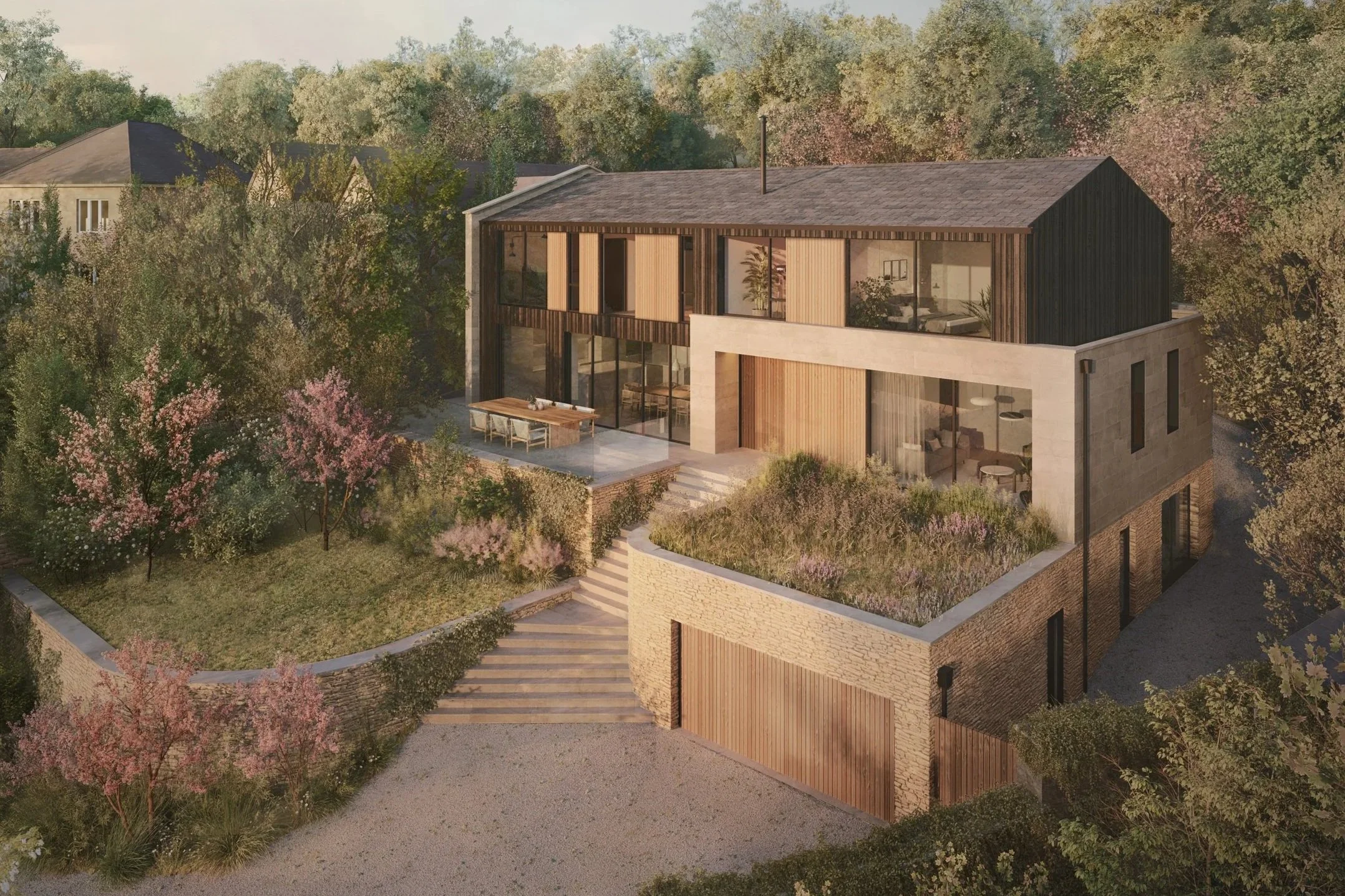
Bonnie Banks - Contemporary new build in Bath
Bonnie Banks is a contemporary five-bedroom detached new build in a sensitive planning context. It occupies an elevated position on a sloping site in the World Heritage City of Bath. The site lies opposite the historic Grade I listed Prior Park, designed by Alexander Pope and Capability Brown.
The brief called for a modern open-plan design with five en-suite bedrooms, extensive glazing, a pyjama lounge, gym, outdoor kitchen and integrated garage.
The house features traditional dressed Bath stone used in a contemporary way — framing the entrance before wrapping around the rear of the property and terminating in a gable that bookends the composition. It is set against bold charred timber and extensive glazing.
Our planning research included the following:
A thorough review of the site’s planning history, including a recent application on the neighbouring site
An assessment of the site’s contribution to the world heritage site and appraisal of the neighbouring listed properties.
Analysis of the surrounding topography and houses
Our planning strategy included:
Ensuring the scale and massing of the building sat comfortably with the neighbouring house
Traditional materials were balanced with contemporary features – as a hilltop house it was important the roof was covered with traditional slate, blending with the local context. This permitted us the freedom to use modern charred timber and slimline glazing on the building’s façade.
We engaged in a pre-application advice process with the council. We negotiated on matters such as the height of the roof and the amount of glazing on the rear elevation. These concessions demonstrated our willingness to collaborate with the council whilst maintaining a truly modern design and without compromising on floor area.
We turn challenges into design features. On this project we needed to provide screening on some of the windows to protect the privacy of the neighbouring garden. Rather than simply frosting the glass, we developed bespoke timber screens that integrated seamlessly with the timber cladding. The result was a cohesive design that satisfied the planners and added a considered crafted detail to the façade.
Start with a feasibility consultation
Every planning journey begins with understanding your site. Book a feasibility consultation with ReFrame Studio to assess your site's potential and define a clear planning strategy before investing in detailed design.